

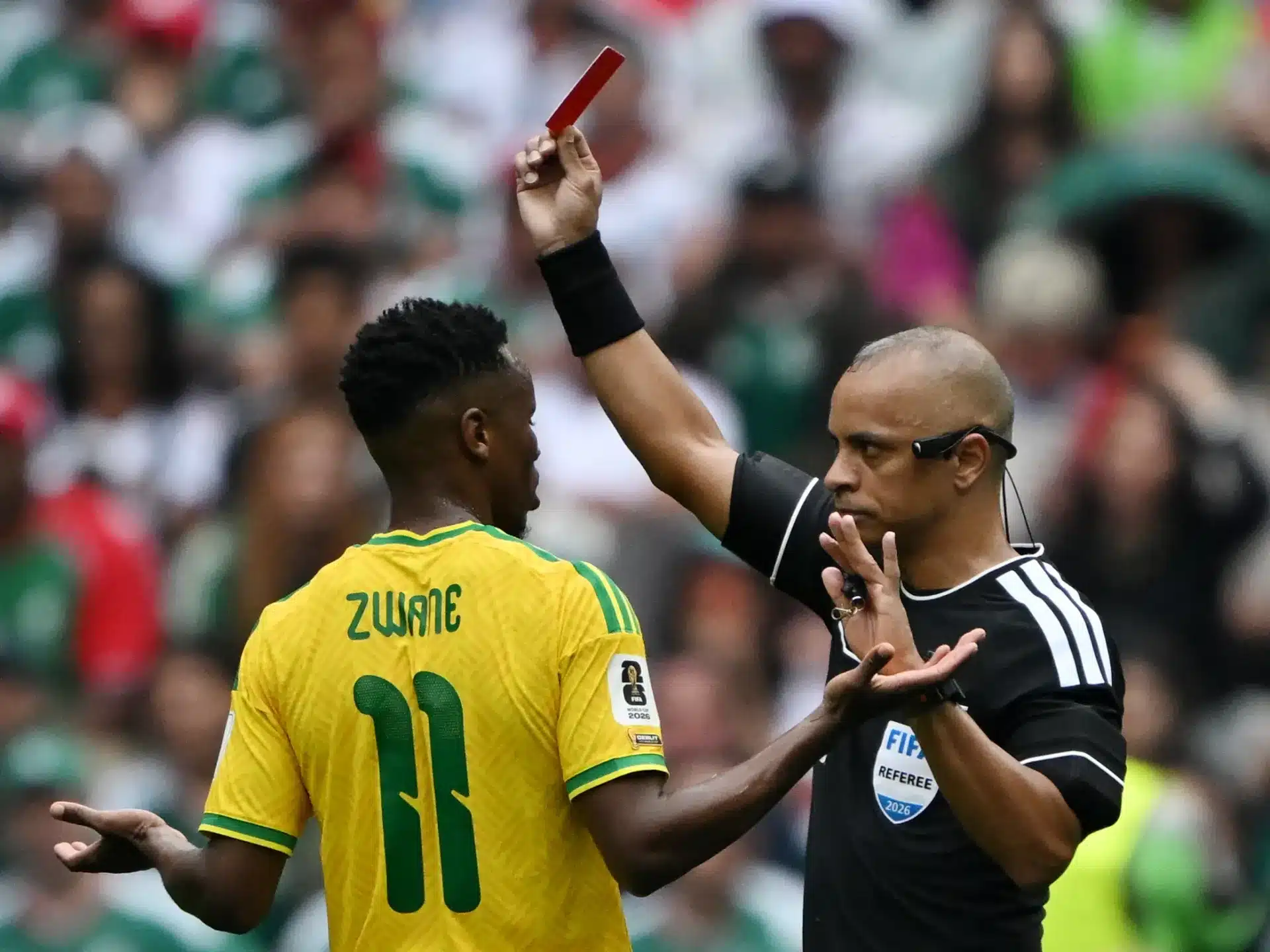
The FIFA World Cup red card rules can have a major impact on a team’s tournament hopes, especially in a short competition where every match matters. From straight reds to second-yellow dismissals, a single moment of indiscipline can change a game, trigger a suspension, and alter a team’s entire path through the knockout stage. With the 2026 World Cup approaching, understanding World Cup card suspension rules has never been more relevant — for fans and bettors alike.
Canada Sports Betting has NO affiliation with FIFA in any capacity. All references to FIFA and the World Cup refer to picks and betting markets from our team of experts.
Why Are Cards Used in Soccer?
Without cards, most soccer games would probably descend into chaos, with nearly every decision — or non-decision — becoming a flashpoint over the course of 90 minutes.
Much like laws, cards are meant to maintain the sport’s civility and integrity, while ensuring that players who break the rules face appropriate consequences. Each yellow and red card decision is made at the discretion of the match referee, who serves as the primary authority on the field.
FIFA yellow card rules exist to caution players for lesser offences, while red cards serve as an immediate dismissal notice for more serious violations. Together, they were introduced to enforce the rulebook, manage player behaviour, protect player safety, and — crucially — provide a visual signal that breaks down language barriers between nations.
History of the Card System
It’s hard to believe, but there was a time not that long ago when no card system existed at all. Referees relied entirely on verbal warnings to caution or dismiss players, which worked well enough in domestic leagues but fell apart the moment two teams who spoke different languages faced each other.
The turning point came at the 1966 World Cup, during a contentious quarterfinal between England and Argentina. Argentina’s captain, Antonio Rattin, was ordered off the field but flatly refused to leave, claiming he hadn’t understood the referee Ken Aston’s instructions. Local police eventually intervened to escort him off the pitch.
Aston, troubled by the incident, began searching for a better solution — one that wouldn’t get lost in translation. His inspiration came from an unlikely source: a traffic light. Yellow for caution. Red for stop. The card system was born, and it was officially introduced at the 1970 World Cup in Mexico, where it has remained ever since.
World Cup Yellow Card Rules
Under FIFA yellow card rules, a yellow card is a caution — serious enough to serve as a warning, but not enough to end a player’s involvement in the match. Referees will sometimes issue a verbal warning first for minor offences, but can produce a yellow card immediately when the situation demands it.
The most important thing to understand: two yellow cards in the same game equals a red card and immediate dismissal.
Yellow cards can be issued for a variety of offences, including:
- Dissent by word or action
- Unsporting behaviour
- Deliberately delaying the restart of play
- Persistent rule infringements
- Entering or leaving the field without the referee’s permission
- Publicly protesting a referee’s decision
- Removing a shirt or covering the head during a goal celebration
Do Yellow Cards Carry Over at the World Cup?
This is one of the most commonly misunderstood aspects of World Cup card suspension rules — so here’s the definitive answer: yes, yellow cards do carry over at the World Cup, but only up to a point.
Under the 2026 World Cup yellow card rules, any player who accumulates two yellow cards across two separate matches before the semifinals will be hit with a one-game suspension. So if a player picks up bookings in his first two group stage games, he’ll miss the third. If he gets his second yellow in the final group game, he sits out the round of 32.
This World Cup card suspension rule applies all the way through the quarterfinals. From the semifinals onward, the slate is wiped clean — yellow card accumulations are reset to ensure that the tournament’s biggest stars are available for its biggest games.
Infamous Yellow Card Moment
The 2006 World Cup produced one of the most bizarre yellow card incidents in the tournament’s history. During Croatia’s group stage clash with England, Croatian defender Josip Simunic was booked three separate times before the referee realized his error — only issuing the red card after that third yellow at the final whistle. It remains one of the most embarrassing officiating blunders in World Cup history.
FIFA World Cup Red Card Rules
If yellow cards shape a tournament, FIFA World Cup red card rules can define it entirely. A red card — whether issued directly or as a result of two yellows in the same match — means an immediate dismissal from the field, no exceptions and no replacement allowed. The offending team is forced to play out the remainder of the game with ten men.
Beyond the immediate impact on the match, World Cup red card rules typically carry suspension consequences that extend into future games, meaning a single reckless challenge can haunt a team for multiple rounds.
Red cards can be issued for offences including:
- Denying the opposition a goal or a clear goal-scoring opportunity through a deliberate handball
- A second caution in the same match
- Serious foul play
- Violent conduct
- Biting or spitting at an opponent or any other person
Players who receive a red card must immediately leave the field and the technical area entirely.
Infamous Red Card Moment
World Cup history is littered with red card moments that changed everything — Luis Suarez’s infamous goal-line handball in 2010, Wayne Rooney’s stamp on a Portuguese player in 2006 — but no red card moment comes close to Zinedine Zidane’s headbutt in the 2006 final. With the game level against Italy, the French legend drove his head into the chest of Marco Materazzi and was dismissed in what would be the final act of his playing career. It’s widely regarded as the moment that cost France the World Cup.
New World Cup Red Card and Yellow Card Rules for 2026
FIFA has introduced several notable rule changes heading into 2026 that directly affect how yellow and red cards are applied.
VAR now has the authority to review yellow card incidents where a second yellow has led to a red card, and can intervene to correct decisions deemed clearly wrong after reviewing replays. VAR can also step in to fix cases of mistaken identity — so if a referee books the wrong player, that can now be corrected.
Only team captains will be permitted to approach the referee when challenging a decision. Any other player who gathers around the official to protest risks picking up a yellow card of their own.
Finally, time-wasting during throw-ins and goal kicks will be punishable by a yellow card if a player takes longer than five seconds to restart play — a rule aimed squarely at the cynical game management tactics that have plagued the sport for decades.
Recap: Red & Yellow Card Rules
From Ken Aston’s traffic light epiphany to Zidane’s infamous headbutt on the grandest stage in football, the card system has been shaping World Cup narratives for over half a century — and the 2026 tournament will be no different. Whether it’s a cynical tactical foul, a reckless lunge, or a player taking four seconds too long over a throw-in under the sport’s new time-wasting rules, the stakes attached to every card have never been higher in a 48-team field where the margin for error is razor-thin. Knowing the difference between a yellow that carries over and one that doesn’t, or understanding exactly when VAR can step in to right a wrong, could mean everything for the teams chasing glory this summer across Canada, Mexico, and the United States — and for the bettors watching closely from home.
FIFA Red & Yellow Card FAQs
The article explains that a red card leads to at least a one-game suspension, but it doesn’t specify whether more serious offences (like violent conduct or biting) result in longer bans. In practice, FIFA’s Disciplinary Committee can extend suspensions beyond one game for serious incidents — for example, violent conduct typically carries a minimum three-match ban.
Yellow card accumulations are only reset from the semifinals onward — not between the group stage and the round of 32. So a yellow card earned in the final group game will carry over into the knockout rounds all the way through the quarterfinals.
The article focuses entirely on player cards and doesn’t mention the technical area at all. In FIFA competitions, coaches and staff on the bench can also be shown yellow or red cards by the referee for misconduct, and a red card results in them being sent from the technical area for the remainder of the match.
VAR can review yellow card incidents where a second yellow led to a red card and correct decisions deemed clearly wrong, and it can also fix cases of mistaken identity. However, the article doesn’t address whether VAR can upgrade or downgrade a direct red card — in practice, VAR can also review whether a direct red card was warranted and recommend an upgrade or downgrade to the referee. canadasportsbetting