
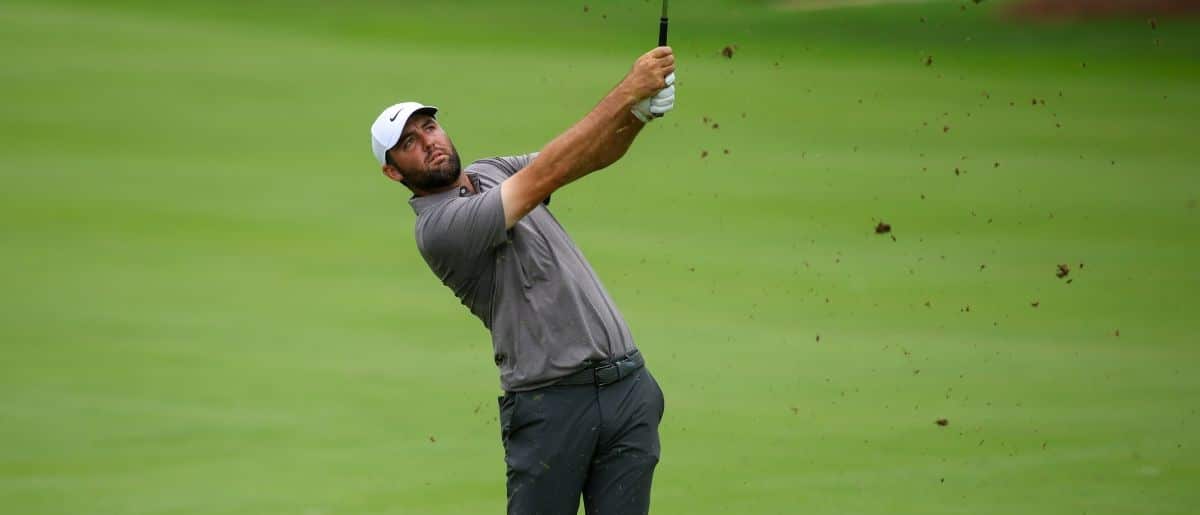
The Hero World Challenge returns to Albany Golf Club in the Bahamas, bringing together an elite group of the world’s top golfers to navigate a unique coastal course known for its demanding layout and stunning scenery. The event is played on a par-72 championship course designed by Ernie Els, spanning over 7,400 yards and blending links golf with desert-style elements and Bahamian influences.
Hero World Challenge Best Bet
It’s no surprise Scottie Scheffler is the outright favourite with just +170 odds to win this event as he eyes the three-peat at Albany Golf Club. It’s a relatively weak field this year, as only four of the top 10 golfers in the World Rankings are in the field (Scheffler, J.J. Spaun, Robert MacIntyre, Justin Rose), with heavyweights Rory McIlroy, Tommy Fleetwood, and Xander Schauffele electing not to play in this exhibition event. Unfortunately, there’s virtually no value in betting on Scheffler to win outright at 37.04% implied odds.
So, who could challenge Scheffler at the top of the leaderboard? Cameron Young (+1100) finished the PGA Tour season strong with four top-10 finishes in his last five events, and then topped things off by co-leading the U.S. at the Ryder Cup with three points. With some significant downtime leading up to this event, though, it’s unclear if he can continue to seize that momentum heading into the Hero World Challenge.
If you’re looking for a long shot, Justin Rose (+2000) is a viable pick. The 45-year-old is still at the top of his game and is coming off another impressive season, and he’s fared well at Albany Golf Club, finishing in the top 10 in each of his last five starts there with a scoring average of 68.95. He cracked the top 5 three times in that span.
Justin Rose to win the Hero World Challenge

Hero World Challenge Outright Odds
| Golfer | Outright Odds |
| Scottie Scheffler | +170 |
| Robert MacIntyre | +1000 |
| Cameron Young | +1100 |
| Keegan Bradley | +1400 |
| Aaron Rai | +1600 |
| Hideki Matsuyama | +1600 |
| J.J. Spaun | +1600 |
| Sam Burns | +1600 |
| Akshay Bhatia | +1800 |
| Justin Rose | +2000 |
| Corey Conners (Canada) | +2500 |
Hero World Challenge Tournament Structure
This week’s Hero World Challenge follows a 72-hole stroke play format with no cut, allowing all competitors to play the full four rounds from Thursday through Sunday. If players are tied at the end, a sudden-death playoff will determine the winner, ensuring top drama and consistent play over every single hole. There are only 20 players in the field.
Albany Golf Course Layout
Albany is famous for its five par 3s and five par 5s—three of each are positioned on the front nine. It’s an Ernie Els design that features links-style fairways, deep sand traps, expansive waste areas, and greens that dip and roll unpredictably. Throughout the course, players must tackle windswept dunes up to 30 feet high and deal with the shifty ocean breeze, adding a challenging dimension that stands out even on the PGA TOUR.
Hole-by-hole, Albany presents a series of skillful tests:
- The opening hole (par 4, 438 yards) demands a precise drive between bunkers and waste areas, setting the tone for the round.
- The second hole (par 3, 193 yards) invites aggressive play but punishes short-sided misses with tough up-and-downs.
- A lengthy par 5 (No. 3, 573 yards) offers an elevated green that makes approaches tricky, especially for those not perfect with layups.
- No. 4 (par 4, 498 yards) is considered one of the toughest, requiring accuracy and distance on both the drive and approach.
- Several holes run alongside expansive water hazards and feature large waste areas, demanding decision-making skills and confident swings.
On the back nine, the 16th stands as perhaps the hardest hole, often playing into the wind with deep bunkers and waste areas making for a daunting approach. Risk-reward decisions come into play at short par 4s like No. 14 and No. 7, both offering chances at eagle or birdie but protected by penal bunkers and elevated greens.
Hero World Challenge Strategic Considerations
The Albany Golf Course demands careful shot placement. Tight fairways are bordered by formidable sand pits and waste areas, while greens vary from narrow approaches to complex undulating surfaces. Ocean winds can shift suddenly, affecting club choice and approach tactics. The tournament’s lack of a cut means golfers need to manage their energy and focus over all 72 holes—aggressive early play can backfire if not balanced with smart course management.
Some holes, like the long par-5 ninth and various peninsula greens, offer spectacular risk-reward opportunities. Water hazards and bunkers often come into play for wayward shots, leading to tough recovery positions and challenging up-and-downs. The closing stretch from holes 16 to 18 is both scenic and nerve-wracking, with water, sand, and strategic bunkering ensuring an exciting finish each round.