
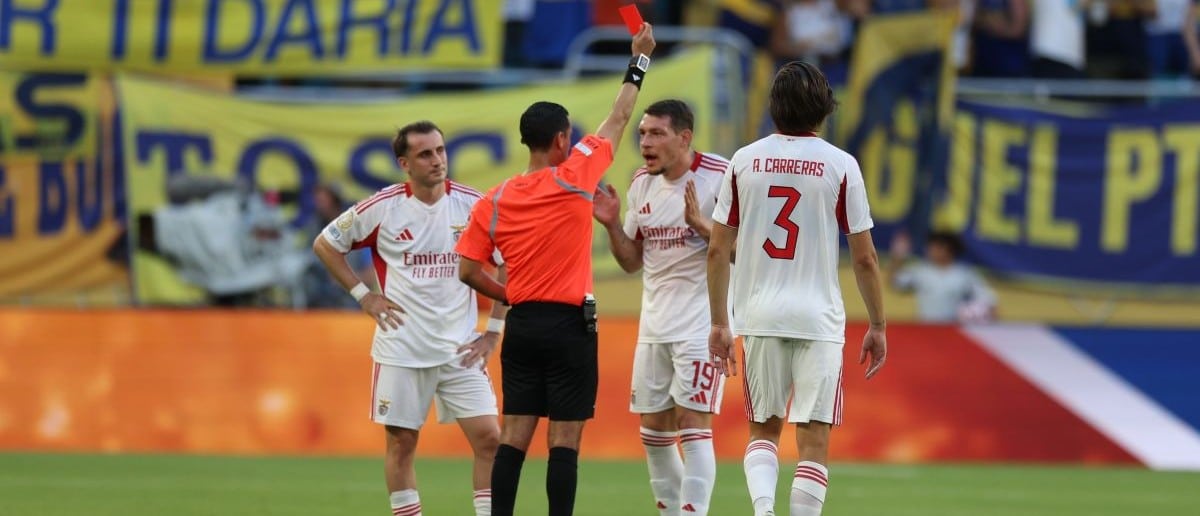
The FIFA World Cup red card rules can have a major impact on a team’s tournament hopes, especially in a short competition where every match matters. From straight reds to second-yellow dismissals, a single moment of discipline can change a game, force a suspension, and even alter a team’s path through the knockout stage.
Why are cards used in soccer?
Without cards, most soccer games would probably descend into chaos with nearly every decision or non-decision throughout the course of 90 minutes.
Much like laws, cards are meant to maintain the sport’s civility and integrity, while ensuring that individuals who break the rules are punished accordingly.
Each yellow and red card decision is made at the discretion of the match referee, who acts as the primary authoritative figure during games.
Cards were implemented for a variety of reasons, with yellow cards acting as a caution while red cards serve as a dismissal notice for players responsible for committing serious offenses.
They were introduced with the aim of enforcing rules, managing player behaviour and ensuring player safety. Furthermore, cards were introduced as a visual signal that breaks down language barriers.
History of the card system
It’s hard to believe, but there was a time not too long ago when there wasn’t a card system at all. Referees relied on verbal warnings to caution or send players off.
The system clearly wasn’t perfect, but it was in place for most of the 20th century.
This method worked in domestic leagues, for the most part, but it was especially difficult when two teams who spoke different languages played against each other.
Then, in 1966, there was a turning point during an infamous World Cup quarterfinal match between England and Argentina. Argentina’s captain, Antonio Rattin, was sent off during the quarterfinal meeting. However, he remained on the field and refused to leave, claiming that he didn’t understand the instructions from the referee, Ken Aston.
Rattin left the field after local police intervened, leading Aston to ponder if there was a better way to communicate referee decisions that would transcend languages.
Aston developed the system used today after being inspired by a traffic light. Yellow cards would serve as a caution, warning players about their behaviour. Meanwhile, red cards were meant to stop players from breaking any more rules, resulting in their immediate dismissal.
The new, traffic light-inspired system was officially introduced at the 1970 World Cup in Mexico.
World Cup yellow card rules
The yellow card isn’t the end of the world. It communicates caution to players who violate certain rules, but it means that their involvement in the game can continue.
It is sometimes issued after a player has been verbally warned by the referee for less serious offences, but can also be issued without warning when players commit violent or cautionable acts.
Players who receive two yellow cards are then shown a red card and immediately dismissed from the match. The initial yellow card is meant to serve as a warning for players to use caution for the rest of the game.
Yellow card cautions can be issued for a variety of reasons, including but not limited to:
- Dissent by word or mouth
- Unsporting behaviour
- Delaying the restart of play
- Persistent infringements
- Entering or leaving the field without the referee’s permission
- Publicly protesting a referee’s decision
- Removal of shirt or covering head during goal celebration
Do yellow cards carry over at the 2026 World Cup?
Yellow cards will be especially impactful at the 2026 World Cup, as players will be issued one-match suspensions if they accumulate two yellow cards in two different matches before the semifinals.
For example, if a player receives two yellow cards in the first two group stage games, he’ll miss his team’s third group game. Or, if a player receives a second yellow card in the last group stage game, he’ll miss the round of 32.
This rule applies right up until the quarterfinals.
The yellow card rule is then reset to ensure that the best players are available to feature in the semifinals and final of the World Cup.
Infamous yellow card moment
A 2006 World Cup group stage game featured one of the most bizarre yellow card incidents in the tournament’s history. During Croatia’s clash with England, Croatian defender Josip Simunic was issued three yellow cards before the match official realized the error. Simunic wasn’t sent off until receiving his third yellow card for a bookable offence at the final whistle.
World Cup red card rules
Red cards are right up there with goals in that they can have a huge influence on the outcomes of soccer games.
Just like players who receive two yellow cards during the same game are sent off, a player who is issued a straight red card, without a caution, also has to leave the field immediately.
Red card violations often include suspension from future games.
A player’s removal from the game could have dire consequences, as teams are then unable to replace the dismissed player with a substitute and are forced to play with fewer players than the opponent.
Red cards can be issued for a variety of reasons, including but not limited to:
- Denying the opposition a goal or a clear goal-scoring opportunity by committing a deliberate handball offence
- Second caution
- Serious foul play
- Violent conduct
- Biting or spitting at someone
Players who get sent off are forced to leave the vicinity of the field and the technical area.
Infamous red card moment
From Luis Suarez’s goal-line handball in 2010 to Wayne Rooney stomping on a Portugal player in 2006, there have been several incidents involving red cards that have been credited with changing the course of World Cup history. But Zinedine Zidane’s headbutt in the 2006 World Cup final is by far the most infamous moment in the tournament’s history. Zidane’s headbutt into the chest of Marco Materazzi not only tainted the Frenchman’s legacy, it is widely cited as the reason France lost the World Cup final against Italy.
New rules for 2026 World Cup
There are some noticeable new rules that FIFA has implemented for the 2026 World Cup.
The Video Assistant Referee (VAR) is now able to intervene and review yellow card incidents that result in a player being shown a red card. VAR will have the authority to correct decisions deemed noticeably incorrect after reviewing video replays.
VAR can also step in to correct errors in cases of mistaken identity when the referee has given a yellow card to the wrong player.
Only team captains will be permitted to approach referees when protesting a decision. Other protesting players who gather around the referee are subject to being cautioned.
Time wasting during throw-ins and goal kicks can also result in a yellow card if players take longer than five seconds to restart games.