
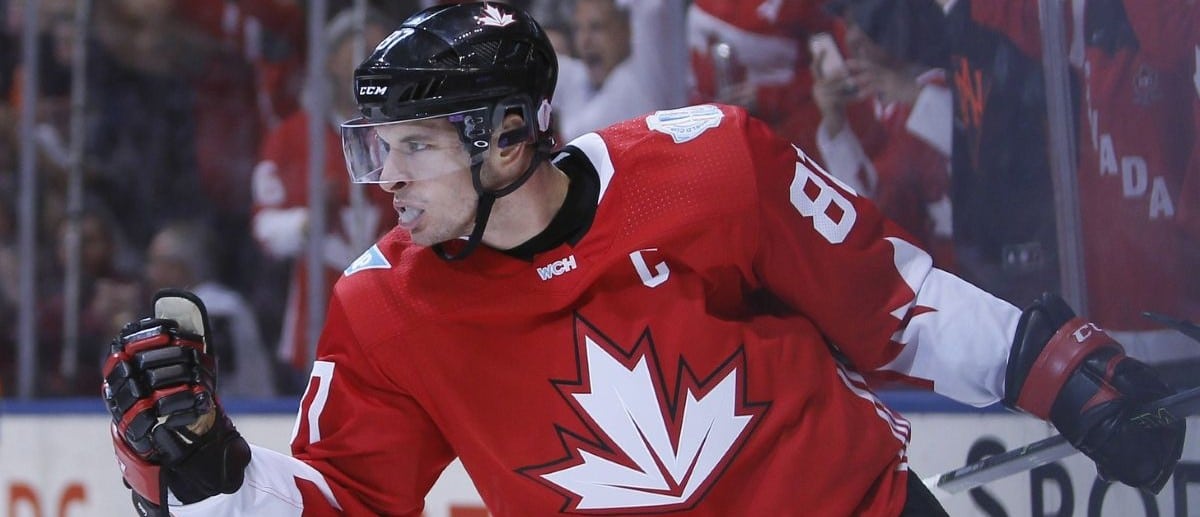
At long last, hockey fans will finally be treated to best-on-best action at the Olympics, with NHL skaters set to participate for the first time since 2014. Team Canada has won three of the last four men’s ice hockey gold medals in tournaments that have featured NHL skaters, including the 2014 tournament, led by captain Sidney Crosby.
With what is on paper one of Canada’s best offensive cores in the history of the program, and coming off a win in last year’s 4 Nations Face-Off, it is no surprise that Canada is once again priced as the favourite to win gold. In this article we will break down Canada’s potential strengths and weaknesses, outright betting odds, schedule, and outline two Olympic Men’s Hockey Team Canada best bets.
Best Futures Bets for Team Canada
Canada to Win Gold: +110
Canada to win gold medal

It’s entirely reasonable to argue that Canada did not bring its best defensive core and still believe that it is a solid bet to win this tournament, even at a seemingly modest price of +110. Canada’s forward corps is the best in the tournament and is going to be a nightmare for any team to keep in check. If things happen to get a little dicey in a knockout phase, head coach Jon Cooper can shrink his bench and almost entirely lean on lines led by McDavid and MacKinnon while playing Makar’s pairing on the back end.
While Canada’s selections were somewhat debatable, Team USA’s options were incredibly puzzling. Though the U.S. will still have several of the game’s very best forwards and arguably a better defensive core than Canada, in reaching too hard for role players they ended up with a forward corps that is far below what Canada is offering, and I believe Canada is likely to end up at around -130 in a likely final with the U.S.
Given my belief that Canada could be that large of a favourite in the toughest possible final, I actually think +110 is a reasonable number. Sweden has ended up with a thinner than expected roster due to some notable injuries and may not be quite as strong as was once expected. The Finns did not fare well in the 4 Nations Tournament, being the only team with numerous average or below-average skaters on the roster, and things will not be any easier with Aleksander Barkov not in the mix.
Nathan MacKinnon Tournament Leading Point-Scorer: +900
Nathan MacKinnon to lead tournament in points
All of the top scorer markets will be a little bit more of a crapshoot than expected, given that how many points a skater racks up versus clear bottom-feeders such as Italy, France and Latvia will likely play into the race quite heavily. Players such as Leon Draisaitl and Tim Stutzle could also be intriguing long shots, because they will likely play huge minutes even in the softer matchups, making them interesting given that they will still be on a solid line together and are still among the best players alive.
Even while giving respect to the possibility and reasoning as to why the tournament-leading scorer could be somewhat off the board, a price of +900 for MacKinnon looks hard to pass up. Canada has a fairly soft preliminary round and gets a matchup versus France in which it’s skaters may score a fairly outrageous total and is then highly likely to make it to the Gold Medal Game.
MacKinnon has put up 1.69 points per game this season in the NHL, compared to McDavid’s mark of 1.66, and McDavid has averaged almost a minute more of time-on-ice. I’d expect both to receive a relatively equal role on the team, and both to skate on the top power-play unit.
For those reasons, I prefer MacKinnon out of the two given his much longer price tag, and believe +900 is good value on for this bet.
Outright Tournament Odds
| Team | Odds to Win Gold Medal | Odds to Medal | Odds to Win Group |
|---|---|---|---|
| Canada | +110 | -550 | -700 (A) |
| USA | +175 | -400 | -1600 (C) |
| Sweden | +750 | -155 | -167 (B) |
| Finland | +1000 | +125 | +150 (B) |
| Czechia | +2500 | +400 | +900 (A) |
| Switzerland | +2500 | +400 | +900 (A) |
| Germany | +5500 | +1100 | +950 (C) |
| Slovakia | +5500 | +1100 | +1600 (B) |
| Denmark | +8000 | +2000 | +5000 (C) |
| Latvia | +50000 | +5000 | +4000 (C) |
| France | +75000 | +20000 | +50000 (A) |
| Italy | +100000 | +30000 | +50000 (B) |
Team Canada Analysis
As would be the case regardless of which players were selected to represent Team Canada, there has been plenty of debate in the hockey world regarding GM Doug Armstrong’s selections. With such a deep pool of talent to choose from, it’s an impossibility to select a roster that would appease all observers.
Regardless of who the fringe players selected were, Canada would always have been the gold medal favourite, given that they are headlined by several of the very best players in the world, such as Connor McDavid, Nathan MacKinnon, Cale Makar, Sidney Crosby and Macklin Celebrini, who any armchair GM would have selected.
The idea that Canada could realistically win gold without sending what is an ideal roster is an important talking point, because the fact that Canada won the 4 Nations Face-Off last February did seem to weigh into the final decisions, which is arguably not the correct approach.
Yes, Canada won the 4 Nations Face-Off. But the fact that it did so should not discredit the flaws that were exhibited at times throughout the tournament. Any somewhat logical combination of Canadian skaters would have been the favourite in that tournament and in this one.
If Canada is likely to falter relative to expectations, a lack of mobility and puck-moving ability among the defensive core will likely be the greatest reason why. At times in the 4 Nations Tournament, Canada’s blue line did not look overly effective, and it seems safe to question whether or not defenders such as Travis Sanheim, Colton Parayko and Drew Doughty would be on this team if Jordan Binnington did not make this flurry of saves in overtime of the Gold Medal Game.
Bringing players back just because you got the winning result when clearly things could have gone differently shouldn’t change the evaluation process regarding what the best possible roster is, because, as noted, any logical Canadian roster would be the favourite to win a best-on-best tournament.
Out of the three more contentious picks on Canada’s blue line, Doughty had the best 4 Nations Tournament and has obviously had a fantastic international career. He’s had a relatively poor NHL season, so Canada is betting that he can elevate his game once again. The same can be said for Parayko, although his case becomes even more debatable because he wasn’t great in the 4 Nations Tournament, while Sanheim has also had a less than dominant season relative to other potential options.
If Canada struggles to generate controlled exits and clean passes to their ultra-talented offensive core, not bringing names such as Matthew Schaefer, Jakob Chychrun, Evan Bouchard, and even Vince Dunn will be hard to defend, especially as the signs were there that the construction of the blue line at the 4 Nations Tournament was not optimal.
While you can argue that they did not bring the perfect blue line, what’s left is still obviously a really strong unit, compiled entirely of well above average NHL skaters, and headlined by arguably the best defender alive in Cale Makar.
Aside from the potential that the defensive core lacks a little bit of play-driving ability, at least relative to Team USA, the other potential concern for Canada is its goaltending, which is a point that has been commonly discussed.
Jordan Binnington was excellent in the 4 Nations final last year and will seemingly get some runway to work as the team’s number-one option as a result. Binnington has arguably been the worst full-time starter in the NHL this season, though, with a -24.9 GSAx rating and .864 save percentage.
If Binnington is to falter, Logan Thompson could be a more suitable number-one option than is seemingly being credited by the majority of analysts. Thompson ranks third in the NHL with a +18.3 GSAx rating this season and finished third in the same metric last year.
One potential concern is that it will be hard for Binnington to play his way out of the starter’s role in the preliminary round but then falter later on, because, as we will break down below, Canada will be a gigantic favourite in each of its three round-robin matchups.
Team Canada Olympic Schedule
Canada will open the tournament with a matchup versus Czechia on February 12th at 10:40 a.m. ET. Czechia is fresh off a World Championship win in 2024, and has typically proven to be a tough out in international play.
While Czechia may be a sneaky candidate to steal a medal in this tournament, that matchup is by a wide margin Canada’s toughest preliminary game, as it will play Switzerland on February 13th at 3:10 p.m. ET, before finishing with a matchup versus France on February 15th at 10:40 a.m. ET.